2009-11-08

Sarpila, Heitger, Allred, Lhotzky, Parrott, Locke - 21st Century caviar

For our listening and visual pleasure, here's a couple of videos ("I Think You're Wonderful" and "Linger Awhile") from the First Annual Arbors Records Invitational Jazz Party that took place in Clearwater, Florida on January 16, 2009. The very cosmopolitan and international line-up is a who's who in the traditional jazz scene of the 21st Century: Antti Sarpila (cl), Duke Heitger (t), John Allred (tb), Bernd Lhotzky (p), Nicki Parrott (b) & the late Eddie Locke (d).


2009-11-06

Donald Lambert - Bells in your head for two weeks

Jim Maher (collaborator with Alec Wilder on American Popular Song) is quoted in James Lester's Too Marvellous For Words: The Life & Genius Of Art Tatum (Oxford University Press, 1994), remembering about the ragtime and stride pianists of the late 1920s and early 1930s:

"I can remember going out to New Jersey to hear Donald Lambert with either Lennie Kunstadt of maybe Rudi Blesh. You'd ask for something, say "Twelfth Street Rag", and instead Donald would launch into "The Bells Of St. Mary's" and he'd go on and on through one variation after another. (...) Sometimes I think about Art Tatum and Eubie Blake and Donald Lambert, and the common thread of their virtuosity. But that was an essential part of the ragtime tradition -pure showmanship and entertainment. They really loved to enthrall you. Oh my God, Donald Lambert could do "The Bells Of St. Mary's" until you'd have bells in your head for two weeks."

--------------------------------------------------

En Too Marvellous For Words: The Life & Genius Of Art Tatum (Oxford University Press, 1994), James Lester cita a Jim Maher (que colaboró con Alec Wilder en American Popular Song) recordando a los pianistas de ragtime y stride de los años 20 y primeros años 30:


"Recuerdo ir a New Jersey a escuchar a Donald Lambert con Lennie Kunstadt o quizás con Rudi Blesh. Pedías algún tema, por ejemplo "Twelfth Street Rag", y en vez de tocarlo, Lambert se lanzaba con "The Bells Of St. Mary's" y seguía interpretando variación tras variación. (..) A veces pienso en Art Tatum, en Eubie Blake y en Donald Lambert, y en el nexo común de su virtuosismo. Pero esa era una parte esencial de la tradición del ragtime: pura teatralidad y diversión. Realmente les encantaba cautivarte. Dios mío, Donald Lambert era capaz de tocar "The Bells Of St. Mary's" hasta que te resonaran las campanas en la cabeza durante dos semanas".

2009-11-04

Leonard Feather on swinging the classics

"The main danger of the whole business of swinging the classics lies in the fact that jazz is laying itself open to an accusation that it lacks new material of its own and is obliged to draw on these themes. Nothing could be further from the truth. Jazz does not need the classics any more than the classics need jazz".

[Leonard Feather - NYTimes, May 18, 1941]


[Click on image to see full size version]

2009-11-03

Rex Stewart - Jazz Festival Time in Old Barcelona

After moving to California in the early 1960s, Rex Stewart contributed jazz reviews regularly to the Los Angeles Times. This one was published on November 12, 1966 and was part of a series of reports on the European jazz scene.


2009-10-27

"Traveling Blues: Life and Music of Tommy Ladnier"

Traveling Blues: Life and Music of Tommy Ladnier by Bo Lindström and Dan Vernhettes has just been published by Jazz'Edit in a limited edition of 500 copies. As an option, you can additionally get a CD containing an archive of the 189 Tommy Ladnier recordings, in mp3 format.


I have already ordered the book but haven't received it yet. However, I have read the Fletcher Henderson chapter, which was published in the two latest IAJRC Journals (Vol.42 nº2 - June 2009 & Vol.42 nº3 - September 2009), and it combines outstanding biographical research and thorough musical analysis (Lindström and Vernhettes have been working on this biography for ten years!). So, the book should be a must-read!

--------------------------------------------------

La editorial Jazz'Edit acaba de publicar Traveling Blues: Life And Music of Tommy Ladnier, de Bo Lindström & Dan Vernhettes, en una edición limitada de 500 ejemplares. Opcionalmente, se puede adquirir un CD con las 189 grabaciones en las que participó Tommy Ladnier, en formato mp3.

Pese a que todavía no he recibido el libro, he podido leer el capítulo dedicado a la época en la que Tommy Ladnier formó parte de la orquesta de Fletcher Henderson, ya que fue publicado en los dos últimos ejemplares del IAJRC Journal (Vol.42 nº2 - June 2009 & Vol.42 nº3 - September 2009). Dicho capítulo combina, a partes iguales, una magnífica investigación biográfica con un concienzudo análisis musical (Lindström y Vernhettes han trabajado durante diez años en esta biografía). Sin duda, ningún aficionado a la música de Tommy Ladnier puede perderse este libro.

2009-10-26

Louis Armstrong & the Carroll Dickerson Orchestra (June 1929)

After his brief stay at the Savoy in New York in March 1929, which had been promoted by OKeh's Tommy Rockwell, Louis Armstrong returned to Chicago, where work was scarcer than before for the Carroll Dickerson Orchestra. From June to late 1929, Louis Armstrong and Dickerson's band would be billed in the New York City musical Connie's Hot Chocolotes, showing at Broadway's Hudson Theater and Connie's Inn.

Here's a hand program from a concert at the Graystone Garden in Detroit, with Satchmo featured as "Lou Armstrong, World's Greatest Trumpet Player", courtesy of Linda Fitak.


2009-10-24

Jelly Roll Pete - mystery solved!

In my post from February 28, I reported on an unknown pianist by the nickname of Jelly Roll Pete and his obscure recording on a label called Hilarity. The identity of this pianist seemed to have been an unsolved mystery for years.

Well, in fact this mystery was solved on August 2008 by Max Keenlyside from the very interesting and scholarly focused Yahoo group "Elite Syncopations".

The pianist is a gentleman named Peter Fahrenholtz, who lives in Denmark. According to the experts from Elite Syncopations (most of them reputed ragtime and oldtime jazz pianists), the playing style is identical, right down to the sustained final chord in each piece, an so are the tone of the piano and the audio quality.

2009-10-15

Sax ads [2] - Martin Handcraft from Hammann-Levin

As these advertisements in the Afro American (from 1928) read, "America's only truly handmade saxophone"...


2009-10-11

Old jazz magazines - record ads [4]

Getting back to my series on old record advertisements from vintage jazz magazines, here's a new installment. Clef magazine (April to July 1946) is the source and labels are West Coast Recordings, Excelsior and Cadet.


2009-10-07

James P. Johnson's last rent party - reviewed

The James P. Johnson Foundation, the Johnson family and Smalls Club organized an all day “rent party” to raise money to buy a monument to commemorate this great musician who so far rests in peace in an unmarked grave in Maspeth, Queens, Mt. Olivet Cemetery.

The concert took place last Sunday, October 4, at Smalls Jazz Club, and Ben Ratliff has reviewed it for the New York Times. Some excerpts are reproduced here:

--------------------------------------------------

Raising Roof and Headstone for Pioneering Pianist
By
BEN RATLIFF
Published: October 5, 2009

"A definition of righteousness: about 75 people, crammed into the West Village club Smalls, watching a series of pianists play James P. Johnson on a grand piano in a benefit concert to buy a headstone for his grave.

(...)

Johnson died in 1955 fairly isolated after four years of illness, and his body lies in an unmarked grave in Maspeth, Queens. The spot was found in February by Scott Brown, a Johnson scholar, and the idea was hatched for “James P. Johnson’s Last Rent Party,” a daylong blowout of Johnsonia at Smalls on Sunday, with historical talks and performances.

The day ended with five hours of solo piano — by 12 performers — and a little bit of four-hands playing. Unlike the Harlem rent parties Johnson used to play, it wasn’t remotely a competition. Though several pianists wrestled with the same material (especially the charging “Carolina Shout”), the emphasis was not on besting one another but on beneficially knocking the tunes around, treating fairly neglected music like common repertory.

Ethan Iverson, the pianist from the Bad Plus, announced that the beginning of his set would be “classical”: an earnest shot at Johnson’s style. He played “Carolina Shout” with sensitivity and clarity, keeping the stride rhythm steady in the left hand. Then he went off into his own updated, posteverything style, full of explicit dissonance, repetition and strange dynamics.

“The Charleston” was his killer: it started with deliberately messy tone rows, his two hands playing at cross-purposes, the left staccato and slow, the right flowing and medium-tempo. Inevitably, and with humor, he finished in the song’s proper style.

Mike Lipskin, a pianist based in San Francisco who studied with the stride pianist Willie (The Lion) Smith, played stride-piano songs as if they were his drinking buddies: his versions of Johnson’s “It Takes Love to Cure the Heart’s Disease” and Luckey Roberts’s “Pork and Beans” were rowdy and familiar, and he made Johnson’s “If I Could Be With You (One Hour Tonight)” mellifluous and lovely, smiling at the audience rather than monitoring the difficult variations in his left-hand stride patterns.

The evening’s revelation was Aaron Diehl, a pianist in his mid-20s who has played with Wynton Marsalis and Wycliffe Gordon. His style, on “Scaling the Blues,” “Over the Bars” and the second movement of Johnson’s “Jazzamine Concerto,” was modest, secure and insinuating, with an iron sense of time. A few different pianists worked in their own tunes as Johnson tributes; Mr. Diehl’s was a slow, gorgeous blues.

Ted Rosenthal and Dick Hyman closed the night. They performed some pieces together at the keyboard, including “Twilight Rag”; then Mr. Hyman, one of the world’s great specialists in early jazz piano, performed Johnson’s music with well-practiced dynamic shifts, elegant and sometimes a bit too showy for the circumstances. But complaining is pointless. Mr. Hyman smoothly played the entire 10-minutes-plus solo-piano version of Johnson’s “Yamekraw,” a rhapsody with classical flourishes and stride interjections. Who else does that?"

--------------------------------------------------

2009-10-05

Sax ads [1] - It's Bueschers...for Count Basie

This post opens a series of musical instruments ads published in different periodicals through the decades. Let's start with jazz nobility...


Music And Rhythm (October 1941)

2009-10-01

Fats Waller On The Air: 1938 Broadcasts

Fats Waller scholar and discographer Stephen Taylor has just released a CD called Fats Waller on the Air: 1938 Broadcasts (TPR-FW0102), containing three complete broadcasts (NBC Broadcast - 12 July 1938, Broadcast to America - 10 September 1938, and Yacht Club Broadcast - 18 October 1938) plus four bonus tracks from vinyl test pressings. The CD includes 30 tracks of which 15 tracks are previously unissued. Stephen has remastered the recordings himself.

You can order it online from his Thomas “Fats” Waller website.


--------------------------------------------------

El estudioso y discógrafo de Fats Waller Stephen Taylor acaba de editar un CD con el nombre de Fats Waller on the Air: 1938 Broadcasts (TPR-FW0102), que contiene tres programas radiofónicos completos (NBC Broadcast, del 12 de julio de 1938, Broadcast to America, del 10 de septiembre de 1938 y Yacht Club Broadcast, del 18 de octubre de 1938), además de cuatro temas extra que proceden de test pressings de vinilo. El CD incluye 30 temas, de los cuales 15 son inéditos. El propio Stephen ha remasterizado las grabaciones.

Se puede adquirir online a través de su web dedicada a Thomas “Fats” Waller.

Jabbo Smith day in Milwaukee

From Chris Albertson's liner notes for Hot Jazz In The Twenties (Biograph BCD 151 & 152):

"In 1961, when I was working for Riverside Records, someone in Milwaukee sent us two reels of tape containing a recent live performance by Jabbo Smith. We were amazed, because -for reasons to which I can find no logic- we assumed that Jabbo had long been dead. In an era of stereo LPs, FM, jet aircraft, post-bop, and nuclear power, Jabbo's 78 rpm discs seemed downright historical, and he -though actually still in his fifties- was, in our minds, "legendary". The truth was that Jabbo had worked and appeared as a sideman on relatively obscure recording sessions during the Thirties, and remained active into the Fifties. The 1961 tapes captured a "comeback" concert sponsored by the Milwaukee Jazz Society, but it failed to get Jabbo into the national spotlight. They were crudely recorded, but Jabbo's work was still impressive. Bil Grauer, the force behind Riverside, was delighted and wanted to see Jabbo continue his career on the label, but that project somehow fell through, so Jabbo Smith remained a local Wisconsin attraction for another 20 years, or so."

To my knowledge, those tapes were never published but other "hidden treasures" from that same year did finally see the light of day: the June 3 and October 15, 1961 recording sessions promoted by guitarist Marty Grosz (Jazz Art TR520699 & TR520700).

Being a Milwaukee resident for several decades, Jabbo Smith got quite a few hommages in his adoptive hometown. In June 1977, he was honored as "a living jazz immortal" at the 4th annual Unlimited Jazz Ltd. Festival on the Memorial Center promenade. The music was provided by some local jazz musicians, and Jabbo refused to play. "How's the lip?," someone asked. "You know," Jabbo shrugged, smiling.

This article was published in the Milwaukee Sentinel on June 27, 1977:


2009-09-25

Those were the times!

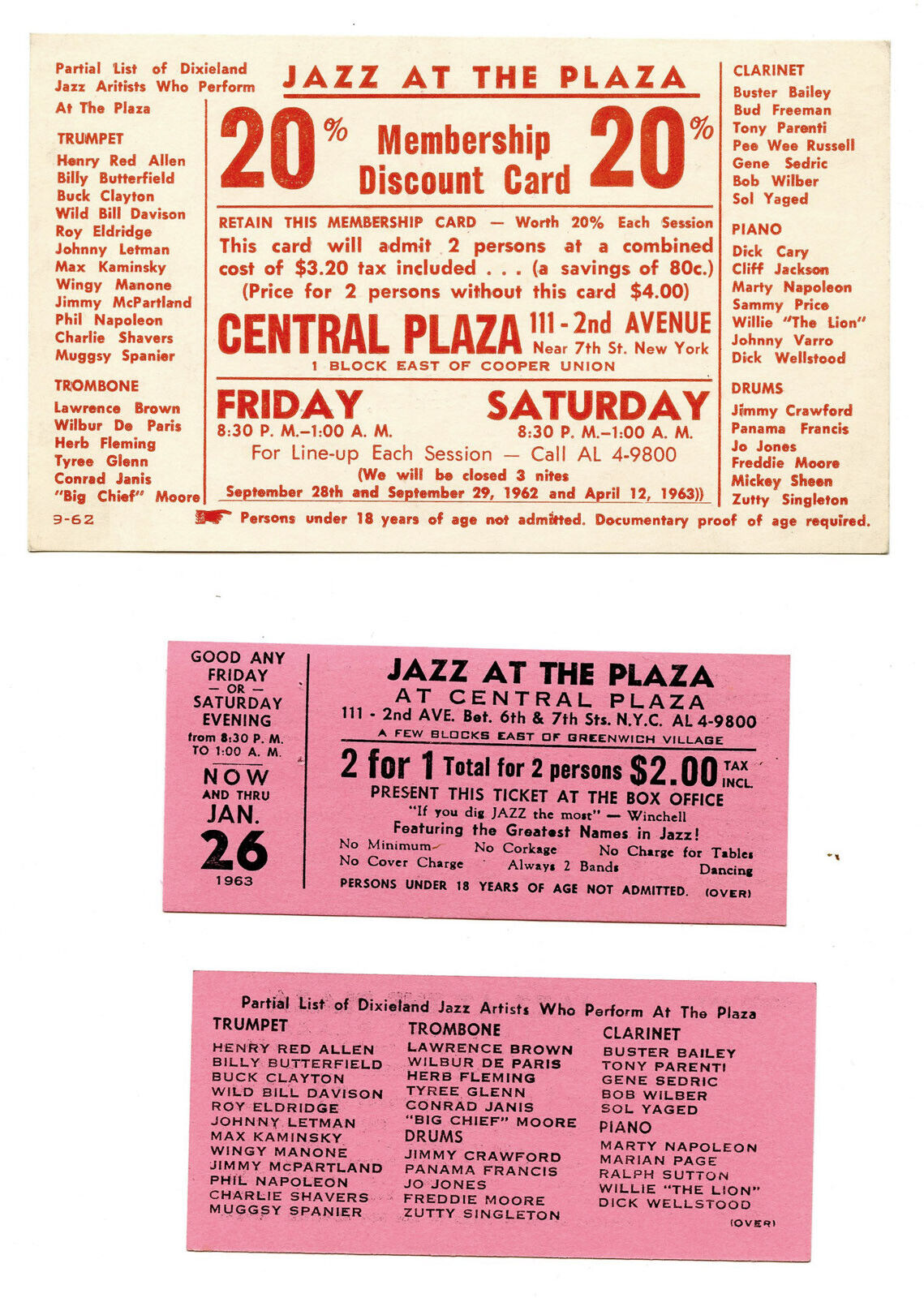
Fletcher Henderson, Peanuts Hucko and Jimmy Crawford at the Central Plaza? Wild Bill Davison, Max Kaminsky, Rex Stewart, Mezz Mezzrow, Bud Freeman and Omer Simeon in the same bill? Henry Red Allen, George Wettling, Pee Wee Russell, Claude Hopkins... Those were the times!


2009-09-24

Clark Terry on Jabbo Smith

"I feel extremely privileged and honored to be on the same planet with Jabbo Smith because he's the man who set down many of the standards that those of us who call ourselves jazz trumpet players follow today. He's a man of deep wit and humor and, of course, he's extremely talented... he has never lost his yen for fun and indulgence in his craft. When I grow up I want to be just like Jabbo."

[Clark Terry, January 1984]

--------------------------------------------------

"Me siento tremendamente privilegiado y honrado de estar en el mismo planeta que Jabbo Smith, porque él es el hombre que estableció muchos de los estándares que seguimos hoy en día los que nos hacemos llamar trompetistas. Es un hombre de profundo ingenio y humor y, por supuesto, tiene muchísimo talento... nunca ha perdido las ganas de divertirse y de regodearse con sus bromas. Cuando sea mayor, quiero ser como Jabbo."

[Clark Terry, enero de 1984]

2009-09-23

Jabbo Smith with the Hot Antic Jazz Band - 1982

The Hot Antic Jazz Band was born in 1979, after a jam session in which five amateur musicians discovered that they had a common passion for the music of the legendary trumpet player Jabbo Smith. They then decided to meet regularly in order to play his repertoire. The funding members were Michel Bastide (cornet and valve trombone), Jean-François Bonnel (clarinet and cornet), Gilles Berrut (piano), Jean-Pierre Dubois (banjo and reeds) and Christian Lefevre (tuba and valve trombone).

In 1982, Jabbo Smith played ten concerts in Europe (Switzerland, Italy and France) with the Hot Antic Jazz Band. This tour, a dream come true for the French band, was organized by Jean-Pierre Daubresse and got immortalized on the CD Jabbo Smith & the Hot Antic Jazz Band (Memories MECD04). In the book Voices Of The Jazz Age: Profiles Of Eight Vintage Jazzmen by Chip Deffaa (University of Illinois Press, 1990), leader Michel Bastide recalls that "It was for us a great shock: Jabbo was playing with a fire, enthusiasm, inventivity, technical possibilities, so far from what we heard in the recordings he did in the 1970s. Of course he was not the Jabbo of 1929, but he was not the tired old man who he was said to be". Just after Smith returned to the United States, he suffered a second stroke which affected the motor control of his voice and some facial muscles.

I will try to write in-depth on Jabbo Smith in the near future but, for the time being, let me bring my diligent readers two youtube.com videos from this 1982 European tour.


2009-09-21

Jabbo Smith - Juan-les-Pins, 1979

Cladys 'Jabbo' Smith was one of the three members in the trumpet triumvirate of the late 1920s (Louis Armstrong -OKeh-, Henry 'Red' Allen -Victor- and himself -Brunswick-) but, in the 1930s, he moved to Milwaukee, which would be his home for many years, alternating with several returns to New York and the musical scene. Back in Milwaukee in the last 1940s, he married and raised two children while playing local gigs as a musician and working for Avis Rent-a-Car during the day.

Rehearsal recordings with Marty Grosz from Jun 3, 1961 were issued as Hidden Treasure on Jazz Art TR-520699/700 (and recently reissued on CD by Lone Hill Jazz), but his real comeback started in the late 1960s, when musicians, fans and record collectors were surprised to learn that the star of those great 1920s recordings was still alive. Smith successfully played with bands and shows in New York, New Orleans, Louisiana, London and France through the 1970s and into the 1980s. He appeared at the 1974 Newport Jazz Festival and four years later at the Village Gate and on tour with the off-Broadway show One Mo' Time.

Here's Jabbo Smith's band at the 1979 Juan-les-Pines Jazz Festival in France with Orange Kellin on clarinet, Waldren 'Frog' Joseph on trombone, Danny Barker on guitar, Lars Edegram on piano, Frank Fields on bass and John Robichaux on drums. This group had previously recorded on December 12, 1978, the album being issued as Jabbo! (Memories ME03). While, obviously, Jabbo is not at the height of his trumpet and vocal powers, he still can take the lead very solidly and play some real hot solos.


2009-09-17

James P. Johnson's last rent party!

James P. Johnson was admitted to Queens General Hospital on November 15, 1955, after having suffered his eighth stroke at home and, on November 17, he died due to a final massive stroke. All the major New York newspapers published his obituary, and he was identified not only as a pianist but also as a prolific composer but, according to Down Beat (December 28, 1955), fewer than 75 persons attended the funeral services at University Chapel in midtown Manhattan two days later.

James P. Johnson, the father of stride piano, composer of The Charleston and The Carolina Shout and one of the founders of modern jazz piano lies, shockingly, in an unmarked grave in Maspeth, Queens, Mt. Olivet Cemetery.

The James P. Johnson Foundation, the Johnson family and Smalls Club have organized an all day “rent party” to raise money to buy a monument to commemorate this great musician. It will take place on Sunday, October 4th beginning at 1:00 PM at Smalls Jazz Club, located at 183 West 10th Street at 7th Avenue.

The afternoon will begin with a symposium by musicologist and Johnson scholar Scott Brown on the life and work of James P. Johnson, followed by Mark Borowsky from the James P. Johnson Foundation and, around 3:00 will then be a steady stream of pianists to play solo piano in tribute to James P. Johnson.

This is the complete schedule:

  • 1:00 PM Doors Open

  • 1:30 PM Opening Words – Barry Glover and The James P. Johson Society

  • 2:00 PM Symposium – James P. Johnson: The Man Who Made The Twenties Roar – Scott E. Brown (this will include an exhibit from The James P. Johnson archive housed at The Rutgers Institute for Jazz Studies)

  • 3:00 PM Symposium - James P. Johnson: Invisible Pianist of the Harlem Renaissance – Mark Borowsky

  • 4:00 PM J. Michael O’Neal and Natalie Wright

  • 4:30 PM John Bunch

  • 5:00 PM Tardo Hammer

  • 5:30 PM Conal Fowkes

  • 6:00 PM Terry Waldo

  • 6:30 PM Spike Wilner

  • 7:00 PM Ethan Iverson

  • 7:30 PM Mike Lipskin

  • 8:00 PM Aaron Diehl

  • 8:30 PM Ted Rosenthal

  • 9:00 PM Dick Hyman


Suggested tax-free donations are $20 with all the proceeds to go to the James P. Johnson Foundation.

2009-09-15

Bessie Smith at the Douglass Theater (Dec. 17-23, 1923)

According to Chris Albertson’s Bessie (Yale University Press, 2003), on December 17, 1923, Bessie Smith returned to the Douglass Theater in Baltimore to fulfil a week’s engagement as a headliner. According to Albertson, “being signed to a major label (Columbia Records) gave Bessie an imprimatur that registered dramatically at the box office: the Douglass’s manager declared the engagement the most successful in the theater’s history”.

Strangely, the following article, published in the Afro American, December 21, 1923, reports that “she (Bessie) expressed disgust at the poor attendance at the Douglass, stating that everywhere else they have appeared they have done turn-away business”.


[Click on image to see full size version]


On December 22, 1923, four months before Bessie’s first contract with Columbia was to expire, the company signed her to a new and better contract: she would record a minimum of twelve sides a year, $200 apiece.

Bessie concluded her week at the Douglass Theater on the following day, and opened Christmas Eve at the Dunbar in Philadelphia.

Here’s an ad for the Douglass Theater engagement, published in the Afro American, December 14, 1923, followed by a photograph of Bessie with a footnote that includes a description of her voice as “full, round, strong and clear with an unusual sweetness, tempered with an original plaintive note that goes straight to the heart of the listener, and has put her on the top round of the vaudeville performers of the race”.


[Click on image to see full size version]


--------------------------------------------------


De acuerdo con el libro “Bessie” (Yale University Press, 2003) de Chris Albertson, el 17 de diciembre de 1923, Bessie Smith volvía al Douglass Theater de Baltimore con un contrato de una semana como cabeza de cartel. Según Albertson, “el tener contrato con una discográfica grande (Columbia Records) le daba a Bessie un estatus que se reflejaba dramáticamente en taquilla: el manager del Douglass declaró esos conciertos como los más exitosos de la historia del teatro”.

Extrañamente, el siguiente artículo, publicado en el Afro American (21 de diciembre de 1923) informaba que “Bessie expresó su disgusto por la poca asistencia de público en el Douglass (…)”.

El 22 de diciembre de 1923, cuatro meses antes de que el primer contrato de Bessie con Columbia expirase, la compañía firmó un nuevo y mejor contrato: Bessie grabaría un mínimo de doce temas al año, a razón de 200 dólares cada uno.

Bessie finalizó su semana en el Douglass Theater el día siguiente y abrió en el Dunbar de Filadelfia en Nochebuena.

Este anuncio de los conciertos en el Douglass Theater se publicó en el Afro American el 14 de diciembre de 1923. A continuación, se adjunta una foto de Bessie Smith (publicada el mismo día) que incluye una descripción de su voz como: “plena, redonda, fuerte y clara, con una dulzura inusual, matizada con un original tono lastimero que va directo al corazón del oyente y la ha colocado en la primera fila de intérpretes de vaudeville de color”.

2009-09-11

El Siglo Del Jazz


La exposición El Siglo Del Jazz, organizada conjuntamente por el Museo d’Arte Moderna e Contemporanea di Trento e Rovereto, el Musée du quai Branly de París y el Centro de Cultura Contemporánea de Barcelona, es un proyecto interdisciplinar dirigido por Daniel Soutif que pretende repasar cien años de historia del jazz tanto a partir de una perspectiva puramente musical como a través de sus interrelaciones con otras artes (pintura, fotografía, cine o diseño gráfico). Se encuentra actualmente en Barcelona (del 22 de julio hasta el 18 de octubre), tras haber pasado por Trento y París.


La muestra se estructura en varias secciones cronológicas (Arqueología del Jazz; La Era del Jazz 1917-1930; La Era del Swing 1930-1939; Tiempos de Guerra 1939-1945; Bebop 1945-1960; La Revolución Free 1960-1980; Época Contemporánea 1980-2002) y supone un viaje fascinante por el mundo del jazz, partiendo de una buena colección de partituras, revistas, libros, carátulas de discos, fotografías, pinturas, dibujos, carteles de conciertos, recortes de prensa y proyecciones.

Tras dos horas de visita, y sin ninguna pretensión crítica ni ánimo de exhaustividad, estos son los tres aspectos que más captaron mi atención:

- Por encima de todo, la magnífica selección de partituras, procedente casi en su totalidad de la colección privada de Philippe Baudoin y que se inicia a mediados del siglo XIX (incluye, por ejemplo, “The Banjo, American Sketch” y “Bamboula” de Louis Moreau Gottschalk o “Music Of The Ethiopian Serenaders”, de 1847) y recoge una buena selección de rags, temas populares de principio de siglo y composiciones del Tin Pan Alley y de la era del swing.


- Otro elemento fascinante es una imitación (en cartón, eso sí) de una Panoram, una de aquellas máquinas que, instaladas en bares, cafeterías y clubs entre 1940 y 1947, permitían reproducir por sólo diez centavos un soundie de tres minutos. La selección proyectada en la exposición incluye ocho soundies, entre ellos el divertido “Your Feet’s Too Big” de Fats Waller o el vibrante “Thanks For The Boogie Ride” de la orquesta de Gene Krupa, con ese picante dúo de Anita O’Day y Roy Eldridge.

- Y para finalizar, la adaptación barcelonesa de la muestra contiene una interesante sección centrada en conciertos históricos acaecidos en la ciudad condal, por lo que incluye una selección de carteles, programas y recortes de prensa y revistas especializadas, con especial referencia a la colección de programas de mano de los conciertos, conferencias y audiciones organizadas por el Hot Club de Barcelona.


2009-09-07

Leonard Feather on Louis Armstrong

This profile of Louis Armstrong was written by Leonard Feather and published in the New York Times on October 26, 1941.


[Click on image to see full size version]

2009-09-04

Will Marion Cook's Clef Club Orch. with Fletcher Henderson

According to Swing Along: The Musical Life Of Will Marion Cook by Marva Griffin Carter (Oxford University Press, 2008), when Will Marion Cook returned from Europe in March 1923, he toured with a 25-piece Clef Club Orchestra, performing at Baltimore's Douglass Theatre (March 23, 1923) and Philadelphia's Dunbar Theater, with 'Paramount Recording Wizard' Fletcher Henderson at the piano.

Here's the ad for the first concert, published in the Afro American, March 16, 1923 (note the "35 Musicians and Players" tag).


[Click on image to see full size version]

2009-09-02

Bessie Smith ads [part 1]

Here's a first batch of Bessie Smith ads, all taken from the Afro American (December 21, 1928). More to come!


[Click on images to see a full size version]

2009-09-01

Leonard Feather on Duke Ellington (NYT, Dec. 1944)

Between May and December 1943, a series of articles on Ellington's Carnegie Hall debut was published in the American magazine Jazz.

John Hammond fired the controversy up with his article "Is The Duke Deserting Jazz?", published in the May 1943 issue, where he criticized Ellington's music (particularly Black, Brown & Beige) for having lost connection with its original function for dancing, and for having become too complex. Hammmond had previously criticized Ellington's Reminiscing In Tempo in his article "The Tragedy Of Duke Ellington", published in the November 1935 issue of Downbeat, for not showing any commitment to social causes.

Leonard Feather, acting both as a critic and as Ellington's press agent, responded to Hammond with a ferocious rebuttal in the May 1943 issue, suggesting possible personal reasons behind Hammond's criticism of Ellington.

Jazz's editor Bob Thiele took a more moderate possition in the July 1943 issue, with an article called "The Case Of Jazz Music". Three other articles were added to this debate: Jake Trussell's "Ellington Hits The Top, And The Bottom" (May 1943) and "In Defense Of Hammond" (July 1943) and Jim Weaver's "Jazz And Ellingtonia" (December 1943).

The following article by Leonard Feather, "The Duke And His Place In Jazz History", was published in the New York Times twelve months after this controversy.


[Click on image to see a full size version]

2009-08-26

Marshall Stearns on James P. Johnson's major works

"Scott Joplin had indicated the ultimate goal, however, when he composed a ragtime opera, Treemonisha, which was performed once only (1915). Similarly, the late James P. Johnson composed coral works, concertos, and symphonies in the same idiom. The inner drive of ragtime composers -like that of most jazzmen- was toward musical respectability, which means one thing: European concepts. But the time was not ripe.

In the early fifties, James P. Johnson, old and sick, often wondered what could have happened to his beloved ragtime. For a brief moment, it seemed that the large compositions on which he had been working were about to be accepted and played, along with the time-honored classics of Mozart and Beethoven. Johnson's concertos were quite as complex and, in a sense, twice as difficult to play as Mozart's. Perhaps his Afro-American folk origins betrayed him, for the average classical musician is utterly incapable of the rhythmic sensitivity that is necessary to play Johnson's pieces. Only an orchestra composed of Smiths [Willie The Lion], Wallers, and Johnsons could have done it."

[Marshall W. Stearns, The Story Of Jazz (Oxford University Press, 1956)]

--------------------------------------------------

"Sin embargo, Scott Joplin había señalado el objetivo final, al componer una ópera ragtime, Treemonisha, que sólo se representó una vez (en 1915). De igual modo, el difunto James P. Johnson compuso obras corales, conciertos y sinfonías con el mismo lenguaje. El empuje interior de los compositores de ragtime -como el de la mayoría de los músicos de jazz- se encaminaba hacia la respetabilidad musical, lo que significa una única cosa: conceptos europeos. Pero no era el momento propicio.

En los primeros años cincuenta, James P. Johnson, viejo y enfermo, se preguntaba a menudo qué le podía haber pasado a su amado ragtime. Por un breve instante parecía que las composiciones extensas en las que había estado trabajando estaban a punto de ser aceptadas e interpretadas, del mismo modo que los clásicos consagrados de Mozart y Beethoven. Los conciertos de Johnson eran tan complejos y, en cierto sentido, el doble de difíciles de interpretar que los de Mozart. Quizá sus orígenes afroamericanos le traicionaron, ya que el músico de clásica medio es absolutamente incapaz de tener la sensibilidad rítmica necesaria para tocar las piezas de Johnson. Sólo una orquesta compuesta de Smiths [Willie The Lion], Wallers y Johnsons lo podría haber hecho."


[Marshall W. Stearns, The Story Of Jazz (Oxford University Press, 1956)]