Mostrando entradas con la etiqueta Coleman Hawkins. Mostrar todas las entradas

2010-08-25

The Mule's 10 random CD picks (2)

* Coleman Hawkins - 1943-1944 (Classics 807)
* Duke Ellington - The Great Chicago Concerts (Music Masters 65110-2)
* Cat Anderson - The Definitive Black & Blue Sessions: Cat Speaks (Black & Blue BB 971.2)
* Luckey Roberts & Willie ‘The Lion’ Smith - Luckey & The Lion: Harlem Piano Solos (Good Time Jazz 10035)
* Rossano Sportiello - Rossano. In The Dark (Blue Swing 002 / Sackville SKCD 2-2070)
* Bennie Wallace - Disorder At The Border. The Music Of Coleman Hawkins (Enja ENJ-9506 2)
* Sarah Vaughan - 1951-1952 (Classics 1296)
* Gene Ammons & Sonny Stitt - God Bless Jug And Sonny (Prestige PRCD-11019-2)
* Wild Bill Davison - Pretty Wild and With Strings Attached (Arbors ARCD 19175)
* Various Artists - The Jazz Piano (Mosaic Singles MCD-1012)

2010-08-17

The Mule's 10 random CD picks (1)

* James P. Johnson - 1942-1945: Piano Solos (Smithsonian Folkways SF CD 40812)
* Willie The Lion Smith - 1938-1940 (Classics 692)
* Marian McPartland - The Single Petal Of A Rose (Concord CCD-4895-2)
* Kenny Davern & Dick Wellstood - Never In A Million Years (Challenge CHR 70019)
* Ben Webster - At The Renaissance (Contemporary/OJC 00025218639026)
* Earl Hines - Four Jazz Giants (Solo Art SACD 111/112)
* Coleman Hawkins - Wrapped Tight (GRP/Impulse! GRD-109)
* Bobby Henderson - Handful Of Keys (Vanguard VMD-8511)
* Lionel Hampton And His Orchestra And Quintet - Jazz Flamenco (RCA 74321364002)
* Various Artists - Prestige First Sessions, Vol. 1 (Prestige PCD-24114-2)

2010-05-21

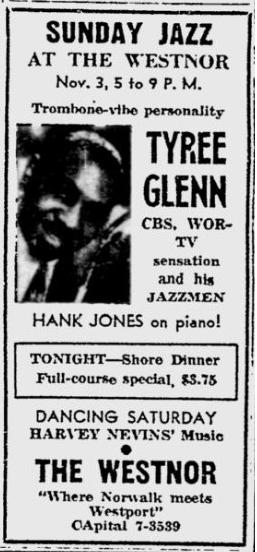
Hank Jones - In memoriam


Jack Teagarden, Dixie Bailey, Mary Lou Williams, Tadd Dameron, Hank Jones, Dizzy Gillespie, and Milt Orent at Mary Lou Williams' apartment, New York, ca. Aug. 1947. Copyright by William P. Gottlieb.


Baltimore AfroAmerican, September 20, 1947


Milwaukee Sentinel, October 10, 1952


Norwalk Hour, November 1, 1957

2010-04-13

Jam session at Jimmy Ryan's: only for your eyes!

Here's a small treasure for all those who love this kind of jazz and would kill to have been present: a flier for a series of 52nd Street jam session at Jimmy Ryan's, starting on September 27, 1942. Click on it and you'll discover a who's who of jazz in the early 1940s:


2010-03-10

That's Got 'Em! - Wilbur Sweatman bio-disco

Reputed jazz scholar Mark Berresford has just published That's Got 'Em! The Life and Music of Wilbur C. Sweatman (University Press of Mississippi), his bio-discography of African American bandleader and clarinetist Wilbur Sweatman, a virtuoso showman who took an important role as a link between ragtime and jazz.


From Berresford's website, Jazz Hound:


Wilbur C. Sweatman (1882-1961) is one of the most important, yet unheralded, African American musicians involved in the transition of ragtime into jazz in the early twentieth century. In That's Got 'Em!, Mark Berresford tracks this energetic pioneer over a seven-decade career. His talent transformed every genre of black music before the advent of rock and roll--"pickaninny" bands, minstrelsy, circus sideshows, vaudeville (both black and white), night clubs, and cabarets. Sweatman was the first African American musician to be offered a long-term recording contract, and he dazzled listeners with jazz clarinet solos before the Original Dixieland Jazz Band's so-called "first jazz records."

Sweatman toured the vaudeville circuit for over twenty years and presented African American music to white music lovers without resorting to the hitherto obligatory "plantation" costumes and blackface makeup. His bands were a fertile breeding ground of young jazz talent, featuring such future stars as Duke Ellington, Coleman Hawkins, and Jimmie Lunceford. Sweatman subsequently played pioneering roles in radio and recording production. His high profile and sterling reputation in both the black and white entertainment communities made him a natural choice for administering the estate of Scott Joplin and other notable black performers and composers.

That's Got 'Em! is the first full-length biography of this pivotal figure in black popular culture, providing a compelling account of his life and times.

Mark Berresford is a writer, rare record dealer, and editor of VJM's Jazz & Blues Mart, the world's oldest jazz and blues record trade magazine. He is the author of Parry Thomas and Pendine and co-author of Black Swan: The Record Label of the Harlem Renaissance.

240 pages (approx.), 6 x 9 inches, 24 b&w illustrations, foreword, bibliography, discography, 4 appendices, index

978-1-60473-099-9 Cloth $50.00


2009-08-23

Coleman Hawkins in Madrid (October 13, 1964)

In my post from February 25, I recalled the story of the two Coleman Hawkins concerts in Barcelona that took place on October 14, 1964 and November 11, 1967 at the Palacio de la Música, both of them musically unsuccessful.

In the former, Hawkins played as part of the Mainstream Jazz Group, one of the ensembles integrated in the European Tour of the Newport Jazz Festival, being the rest of the musicians Harry 'Sweets' Edison (trumpet), Sir Charles Thompson (piano), Jimmy Woode (bass) and Jo Jones (drums).


This group had played the day before in Madrid, at the Carlos III theatre, with similar almost chaotic results. It was Juan Pedro Bourbon, owner of the mythical Whisky Jazz club, who did manage to bring this Mainstream Jazz Group to Madrid.

Juan José González, veteran jazz enthusiast and faithful reader of this blog who attended this concert 45 years ago, recalls how Jo Jones left the stage a few minutes after the concert started, reportedly saying "I don't want to play with that old man!". According to Juan José, Hawk got on the stage walking clumsily and started the concert playing in kind of a bebop style, very different from the way this group had been playing before, and this infuriated Jo Jones. Harry Edison, on his feet, took one of the sticks and started to keep the rhythm on the cymbals, while Coleman Hawkins and Sir Charles Thompson soloed, and then he played his solo choruses with a two-men rhythm section, no drums.


In the November issue of Aria Jazz magazine, an article called "Two Empty Seats" was published, in reference to Jo Jones' and Juan Pedro Bourbon's, who went to the police to report Jo Jones for breach of contract. Bourbon wrote "I regret to say that the great Coleman Hawkins turned up at the Carlos III completely drunk" in the Aria Jazz article.

According to the ABC (Spanish newspaper) TV listings, the following two programs of Discorama (Sunday, October 18 and Sunday, October 25) were dedicated to Coleman Hawkins. Discorama used to be recorded at the studio and, so far, I haven't been able to find any confirmation whether these programs were telecasts of the concert at the Carlos III or they were studio recordings. Any help would be much appreciated.

2009-07-03

Fletcher Henderson - New Albert Theatre ad (May 3, 1930)

This concert ad was published in The Afro American (May 3, 1930). Fletcher Henderson's orchestra was going to play at the New Albert Theatre, Baltimore, and it strikes me that, among this amazing constellation of stars (Rex Stewart, Jimmy Harrison or Coleman Hawkins, to name a few), this advertisement underlines drummer Kaiser Marshall, "the world's greatest drummer".


2009-04-18

Benny Carter and the QHCF in Barcelona (Jan. 29&31, 1936) [ENG]

After two minor festivals in the summer and the autumn of 1935, the Hot Club of Barcelona went to town signing Benny Carter and the Quintet of the Hot Club of France including Django Reinhardt and Stéphane Grappelli for the III Festival de Jazz (January 1936).


Quintet of the Hot Club of France bandmembers were playing in a variety of ensembles and regrouped for the Spanish tour; telegrams were sent to Stéphane in Monte Carlo, and he flew to Barcelona to join the ensemble.

Benny Carter had arrived in Paris in 1935 to play with the Willie Lewis orchestra and would stay in Europe until 1938, as an arranger for the BBC orchestra (at Leonard Feather’s suggestion) and travelling all over Europe, playing and recording with the top-notch British, French and Scandinavian jazz musicians, as well as with other American expatriates such as Coleman Hawkins.


The two Barcelona concerts took place on January 29 and 31, 1936, at the Cine Coliseum and the Palau de la Música Catalana, respectively. On both concerts, Benny Carter played accompanied by the Hot Club of Barcelona Orchestra, conducted by pianist Antonio Matas and made up of outstanding jazzmen from the best orchestras in town, such as Sebastián Albalat (tenor sax), Magín Munill (trumpet) and José Bellés (drums) from the Napoleon’s Band, Francisco Gabarró (trombone) from the Miuras de Sobré, José Domínguez (alto sax) and Fernando Carriedo (trombone) from the Matas Band, José Ribalta (trumpet) and Steve Ericsson (guitar) from the Demon’s Jazz, Antonio Russell (bass) from the Casanovas Orchestra and José Masó (trumpet) from the 16 Artistas Unidos.


Both concerts were a great success and reviews on newspapers were unstinting in their praise, except for JLL from La Veu De Catalunya, who called Benny Carter “an authentic black man playing the most ignoble of the musical instruments” and described the Quintet of the Hot Club of France as “five white men mimicking black men’s primitivism”. [1]. In return, Benny Carter praised the Spanish musicians’ musicality and their outstanding ability to improvise, stating that “I’m amazed by your jazz professionals” [2]. This dedication was published on the cover of Jazz Magazine (official magazine of the Hot Club of Barcelona), #5, February 1936:

“In as few words as possible I should like to thank the members of the Hot Club and also the general public of Barcelona for the enthusiasm shown at my concert. I may truly say that I have enjoyed playing for you much more than you enjoyed listening. Nevertheless, thanks for listening.

Musically Yours,
Benny Carter”


Grappelli recalls that “we had a magnificent reception marked by all the warmth and enthusiasm the Spaniards are capable of. After each concert, hats rained down onto the stage as though it were a bullfight. It was marvellous!”


I’ve found two mentions of additional concerts, but my research to find any document brought no results:

-José María García Martínez, in his book Del Fox-Trot Al Jazz Flamenco. El Jazz En España 1919-1996 (Alianza Editorial, 1996), mentions an extra concert at the Teatro Olimpia, with Jaume Vila sitting in for Stéphane Grappelli, who refused to play.

-Michel Dregni, in Django: The Life And Music Of A Gipsy Legend (Oxford University Press, 2004), states that “the tour began at the Cinema Coliseum on January 29 and 30 and continued at Musica Catalana (sic) on January 31 and February 1 (…). In the end, the Spanish tour was a resounding success (…) and the Quintette played double the concerts scheduled”. In my opinion, according to advertisements and reviews published in La Vanguardia (see images), this possibility is nearly ruled out.


Coda: Dregni also tells this story, not mentioned neither in Chema García’s book nor in Jazz En Barcelona 1920-1965 by Jordi Pujol Baulenas (Almendra Music, 2005) and for which I have found no evidence in the archives of the newspapers from this period. According to Dregni, “when the applause ended, a surprise awaited the musicians. The concert organizer had departed with the proceeds. The band was paid an advance of 3.000 francs before leaving Paris, but now the balance of 4.000 francs plus their travel expenses were gone. Django, Carter, and the bandmates pooled the money in their pockets to afford train tickets home, with one lone Catalonian sausage to slice up between them to quell their stomachs on the long journey to Paris”. You can smell a faint whiff of literature –call it fable or legend- in this passage.

-------------------------------------------------

[1] Quoted by N. Suris in “Así se hace la crítica”, Jazz Magazine, March 1936
[2] N. Suris: “Benny Carter nos hace confidencias”, Jazz Magazine, February 1936

2009-04-16

Benny Carter and the QHCF in Barcelona (Jan. 29&31, 1936) [ESP]

This is the chronicle of the concerts that Benny Carter, on one hand, and the Quintet of the Hot Club of France, on the other, gave in Barcelona in early 1936. I'll start with the Spanish version, but my foreign readers can be sure they'll have their English version.

--------------------------------------------------

Tras dos minifestivales de menor calado en el verano y el otoño de 1935, el Hot Club de Barcelona tiró la casa por la ventana para su III Festival de Jazz (enero de 1936), contratando a Benny Carter y al Quinteto del Hot Club de Francia que incluía a Django Reinhardt y Stéphane Grappelli.


Los miembros del Quinteto del Hot Club de Francia estaban por aquellas fechas dispersos en varios grupos distintos y se reagruparon para las actuaciones de Barcelona. En concreto, Stéphane Grappelli se encontraba en Monte Carlo y hubo que enviarle un telegrama para que cogiera un avión y se presentara en Barcelona.

Benny Carter había llegado a París en 1935 para tocar con la orquesta de Willie Lewis y permanecería en Europa hasta 1938, empleado como arreglista de la orquesta de la BBC (por sugerencia de Leonard Feather) y viajando por toda Europa, tocando y grabando con los mejores músicos de jazz británicos, franceses y escandinavos, así como con otros expatriados norteamericanos como Coleman Hawkins.


Los conciertos barceloneses tuvieron lugar los días 29 y 31 de enero de 1936 en el Cine Coliseum y en el Palau de la Música Catalana, respectivamente. En ambos, Benny Carter tocó acompañado por la Orquesta del Hot Club de Barcelona, dirigida por su pianista Antonio Matas e integrada por destacados jazzmen pertenecientes a algunas de las mejores orquestas de la ciudad, como Sebastián Albalat (saxo tenor), Magín Munill (trompeta) y José Bellés (batería) de la Napoleon’s Band, Francisco Gabarró (trombón) de los Miuras de Sobré, José Domínguez (saxo alto) y Fernando Carriedo (trombón) de la Matas Band, José Ribalta (trompeta) y Steve Ericsson (guitarra) de la Demon’s Jazz, Antonio Russell (contrabajo) de la Casanovas Orchestra y José Masó (trompeta) de Los 16 Artistas Unidos.


Los dos conciertos tuvieron un gran éxito de público y todas las actuaciones fueron reseñadas con elogio por los periódicos barceloneses, a excepción de JLL en La Veu De Catalunya, quien tildó a Benny Carter de “negro auténtico que toca el más innoble de los instrumentos musicales” y describió al Quinteto del Hot Club de Francia como “cinco blancos que imitan el primitivismo de los negros” [1]. Recíprocamente, Benny Carter elogió la musicalidad y la notable capacidad de improvisar de los músicos españoles, declarando que “vuestros profesionales del jazz me han dejado pasmado” [2]. Esta es la dedicatoria firmada por el músico americano que apareció en la portada de Jazz Magazine (revista oficial del Hot Club de Barcelona), número 5, febrero 1936, Año II:

“In as few words as possible I should like to thank the members of the Hot Club and also the general public of Barcelona for the enthusiasm shown at my concert. I may truly say that I have enjoyed playing for you much more than you enjoyed listening. Nevertheless, thanks for listening.

Musically Yours,
Benny Carter”


Por su parte, Grappelli recuerda que “tuvimos una magnífica recepción marcada por la cordialidad y el entusiasmo de los españoles. Después de cada concierto, el escenario quedó sembrado de sombreros, como si fuera una corrida de toros. ¡Fue maravilloso!”


Existen dos menciones a conciertos adicionales de los que no he podido obtener ninguna evidencia documental:

-José María García Martínez, en su libro Del Fox-Trot Al Jazz Flamenco. El Jazz En España 1919-1996 (Alianza Editorial, 1996), hace referencia a un recital extra que se acordó celebrar en el Teatro Olimpia, en el que Stéphane Grappelli se negó a intervenir, siendo sustituido por Jaume Vila.

-Michel Dregni, en Django: The Life And Music Of A Gipsy Legend (Oxford University Press, 2004), señala que “la gira barcelonesa del Quinteto del Hot Club de Francia comenzó en el Cinema Coliseum los días 29 y 30 de enero y continuó en la Música Catalana (sic) los días 31 de enero y 1 de febrero”, con el doble de actuaciones de las previstas. En mi opinión, y de acuerdo con los anuncios y las reseñas de esta gira publicados en La Vanguardia (ver imágenes), esta posibilidad queda prácticamente descartada.


Para concluir, Dregni también narra una anécdota que no se menciona ni en el libro de Chema García ni en Jazz En Barcelona 1920-1965 de Jordi Pujol Baulenas (Almendra Music, 2005), y para la que tampoco he encontrado ninguna evidencia en los archivos de los periódicos de la época. Según Dregni, “el organizador del concierto desapareció con las ganancias. El Quinteto del Hot Club de Francia había recibido 3.000 francos por anticipado antes de salir de París, pero nunca cobró los restantes 4.000 francos ni los gastos del viaje. Los músicos tuvieron que rascarse los bolsillos para pagar los billetes de vuelta en el tren, y tuvieron que compartir una butifarra catalana para acallar sus estómagos en el largo viaje a París”. Un tufillo literario, ya sea fábula o leyenda, asoma en este pasaje.

-------------------------------------------------

[1] Citado por N. Suris en “Así se hace la crítica”, Jazz Magazine, marzo 1936
[2] N. Suris: “Benny Carter nos hace confidencias”, Jazz Magazine, febrero 1936

2009-04-10

Old jazz magazines - record ads [3]

Here's the third installment of my series on old record advertisements from vintage jazz magazines. This time the source is Needle (from June 1944 to December 1944) and labels are Asch, Apollo, Blue Note, Savoy and the very rare S.D.


2009-03-10

Joe Turner on French TV (60s)

Stride pianist Joe Turner first visited Europe accompanying singer Adelaide Hall (1935-1936), and he stayed in the Continent until the beginning of World War II. During this period, he cut some records in Paris (among them one cannot forget his "specialty" arrangement of "Liza" for the French Ultraphone label, coupled with "Cheek To Cheek"), Bern or Prague. Reportedly, a private recording of Coleman Hawkins (on tenor sax, piano and vocals!) and Joe Turner does exist (Zurich, April 1936).

When Turner returned home, he joined Sy Oliver's service band at Camp Kilmer in New Jersey, then playing as a soloist in New York (1939-1943) or as part of Rex Stewart's orchestra.

By 1948, he came back to Europe for good, variously headquartered in Hungary, Czechoslovakia, Switzerland, London and Paris, where he was featured regularly from 1962 on at "La Calvados", a bar off the Champs Elysées. Here's where, according to Siegfried H. Mohr, on March 3, 1990, Ralph Sutton, François Rilhac and Louis Mazetier joined him in a truly memorable kind of Stride Piano Summit.

Here you have a few Dailymotion Joe Turner gems, from a rare French TV program from the Sixties, Jazz Session. The other featured musician on this program was Champion Jack Dupree.


2009-03-06

Bud Freeman - Eeling his way into the 70s

I would say Bud Freeman is a case where the inverse of the “you can’t see the wood for the trees” saying would be applicable. His incredibly lengthy and extraordinarily consistent recording career, covering sixty years from his first session with McKenzie and Condon’s Chicagoans in 1927 to his final recording as a guest in Mat Matthews And Friends (Audiophile AP-219, from 1986) overshadows the raw quality of each of his discs, his performances and his solos.

The above mentioned consistency stayed up until he was in his 80s, and what follows is a very personal selection of six discs from his last twenty years, with the only common links of being easily available on CD and having relatively unknown or, at least, not star-like rhythm sections and colleague hornmen (one exception to both characteristics is the Bucky Pizzarelli disc). Oh, yes, I know Alex Welsh was an outstanding trumpetist and a well respected institution in the British trad jazz scene, and Howard Alden is a must everywhere there’s a mainstream jazz session, but you know what I mean.

By listening to these discs you’ll discover that his commitment to his own style is present even in his 70s. He developed it in the early-to-mid 30s, as an alternative approach on the tenor to the harder-toned style of Coleman Hawkins and we cannot forget he was a strong influence in Lester Young, though Freeman’s tone has more of an edge than Young’s and though rhythmically there are similarities with the earlier style of Coleman Hawkins. His instantly recognizable convoluted phrasing, his old frantic drive and his trademark licks in the uptempo numbers are still present on these discs, as is his highly personal way of treating ballads, tender but with no sentimentality, and his moderate and intelligent use of vibrato.

Detractors say he had been playing the very same solo since he recorded “The Eel” with Eddie Condon and his Orchestra in 1933. So much the worse for them!

--------------------------------------------------

Podría decirse que a Bud Freeman le sería aplicable el inverso del refrán “los árboles no dejan ver el bosque”. La increíble duración y la extraordinaria consistencia de su carrera en los estudios de grabación durante sesenta años, desde su primera sesión con los Chicagoans de Red McKenzie y Eddie Condon en 1927 hasta su última grabación como invitado en el disco Mat Matthews And Friends (Audiophile AP-219, de 1986) eclipsa la calidad en estado puro de sus discos y sus solos.

Esta consistencia se mantuvo hasta incluso después de cumplidos los ochenta. Aquí se presenta una selección muy personal de seis discos grabados en los veinte últimos años de su carrera, con los únicos vínculos comunes de estar disponibles en CD y de contar con el acompañamiento de músicos no demasiado conocidos (con la excepción, en ambos casos, del disco con Bucky Pizzarelli). Todo ello con el máximo respeto a Alex Welsh, destacado trompetista y toda una institución altamente respetada en la escena del jazz tradicional británico y a Howard Alden, un fichaje obligado en cualquier sesión de jazz mainstream.

Al escuchar estos discos se hace patente que el compromiso de Bud Freeman con su propia forma de tocar el saxo tenor persiste en su vejez. Freeman desarrolló su estilo definitivo en los primeros años 30, como una alternativa al de Coleman Hawkins (de tono más poderoso) y fue una clara influencia en el de Lester Young, aunque el tono de Freeman tiene más aristas y rítmicamente existen ciertas similitudes con el estilo temprano de Hawkins. Su fraseo enrevesado y reconocible al instante, su frenético empuje y sus licks marca de la casa en los tiempos rápidos siguen presentes en estas grabaciones, al igual que su manera muy personal de afrontar las baladas, delicada pero sin caer en sentimentalismos, y su uso moderado e inteligente del vibrato.

Sus detractores le achacan que estuvo tocando el mismo solo desde que grabó “The Eel” con la orquesta de Eddie Condon en 1933. ¡Peor para ellos!

--------------------------------------------------


Bud Freeman With Alex Welsh & His Band (Lake Records, LACD 183)
Recorded at Manchester Sports Guild, June 19, 1966
Bud Freeman (ts); Alex Welsh (t, voc); Roy Williams (tb); John Barnes (cl, bs); Jim Douglas (g); Fred Hunt (p); Ron Matthewson (b); Lennie Hastings (d)


Bud Freeman And The Keith Ingham Trio – Superbud (originally on 77 Records, catalog number S55, reissued on CD on Jazzology JCD-185)
Recorded in London, August 13, 1974
Bud Freeman (ts); Keith Ingham (p); Pete Chapman (b); Johnny Armitage (d)


Bucky Pizzarelli With Bud Freeman – Bucky And Bud (Flying Dutchman BDL1-1378)
Recorded in New York, 1976
Bud Freeman (ts); Bucky Pizzarelli (g); Hank Jones (p); Bob Haggart (b); Ron Traxler (d)


Bud Freeman – The Man. Live In Dublin 1976 (Nagel Heyer 105)
Recorded in Dublin, 1976.
Bud Freeman (ts); Noel Kelehan (p); Jimmy McKay (b); Jack Daly or John Wadham (d)


Bud Freeman – The Dolphin Has A Message (JSP CD882)
Recorded in London, May 1980
Bud Freeman (ts); Brian Lemon (p); Len Skeat (b); John Richardson (d)


Bud Freeman – California Session (Jazzology JCD-277)
Recorded at the Skytrails Restaurant, Van Nuys, California, January 9, 1982
Bud Freeman (ts); Dick Cathcart (t); Betty O’Hara (tb); Bob Reitmeier (cl); Ray Sherman (p); Howard Alden (g); Phil Stephens (b); Nick Fatool (d)

--------------------------------------------------

A bit of Jazz Trivia and a taste of Bud Freeman’s sense of humour:
After trombonist Betty O’Hara soaring solo on “Struttin’ With Some Barbecue” (from California Session), Bud Freeman kissed her on the cheek. Then you can hear him say, “Oh, that’s the first time I’ve ever kissed a trombone player.”

2009-02-25

Coleman Hawkins - Wembley Town Hall, October 2, 1964

Michel Steinman's comment on my previous post regarding Coleman Hawkins' Fall 1964 European Tour with the Mainstream Jazz Group reminded us that there's a video from it available at YouTube and Fernando Ortiz de Urbina mentions that it may be a BBC TV broadcast, Jazz 625, hosted by Steve Race (then Humphrey Lyttelton) and that a collection of Jazz 625s in VHS video was released in the mid-90s, but there has not been an official DVD reissue by the BBC.

Both are right. That concert took place on October 2, 1964 at the Wembley Town Hall, London, and there are four different pieces available at Dailymotion:


Hawkins-Centrepiece
Cargado por boberwig


Hawkins-September song
Cargado por boberwig


Coleman Hawkins-Stoned-
Cargado por boberwig


Caravan- Jo Jones
Cargado por boberwig


Don't miss that Jo Jones solo on "Caravan" which is also a favourite of mine.

Coleman Hawkins in Barcelona: Oct. 1964 & Nov. 1967

For the high and mighty hawk, the 1964-1969 years were a mixed bag of peaks of fertile creativity and periods of critically poor health condition, the latter clearly predominating in his last three years, due to alcoholism and a bad (or better, the lack of any) diet.


The Barcelona jazz aficionado from the 60s was extremely blessed to be able to attend two different Coleman Hawkins performances in just three years, though neither of them was musically successful, for two different reasons: battle of egos between Hawkins and Edison in the October 1964 concert and extreme physical weakness in the November 1967 date.


On October 14, 1964, Coleman Hawkins played at the Palacio de la Música Catalana (Barcelona) as part of the Mainstream Jazz Group, one of the ensembles integrated in the European Tour of the Newport Jazz Festival. The rest of the musicians were Harry 'Sweets' Edison (trumpet), Sir Charles Thompson (piano), Jimmy Woode (bass) and Jo Jones (drums). Reportedly, unrest from Hawkins and Edison was obvious during the concert, and every time Edison started a solo, Hawkins went backstage to handle his bottle of cognac. Jo Jones spent half the concert having murderous looks at both hornmen and the other half trying to keep the music alive. Albert Mallofré's review for the weekly magazine Destino highlighted Edison's brilliant playing and Hawkins' bad shape and pointed out that the winner was clearly Jo Jones. Reportedly the concert ended with a strong ovation that turned into annoyance and deception when Hawkins refused to play an encore.


On November 11, 1967, Coleman Hawkins played again at the Palacio de la Música, this time as part of the II Festival Internacional de Jazz de Barcelona. In late 1967, after his serious health issues from several months before (reaching its worst at the Oakland concert on June 30 after which he was hospitalized in Los Angeles the next day), Hawkins managed to make a European Tour, promoted by Norman Granz. The first round of dates was a series of concerts with the Oscar Peterson Trio (Sam Jones on bass and Bobby Durham on drums). According to his biographer John Chilton "Hawk was not in a robust mood for any of the shows, but he was generally in command of his saxophone. When he couldn't get what he termed 'the right kind of food' he went without, and inevitably this produced some uneven performances". This november 11 concert was one of them, and Hawkins was booed by a number of people in the audience. See Alberto Mallofré's review for La Vanguardia for more details.


Sad but true, the Hawk didn't fly high this time.